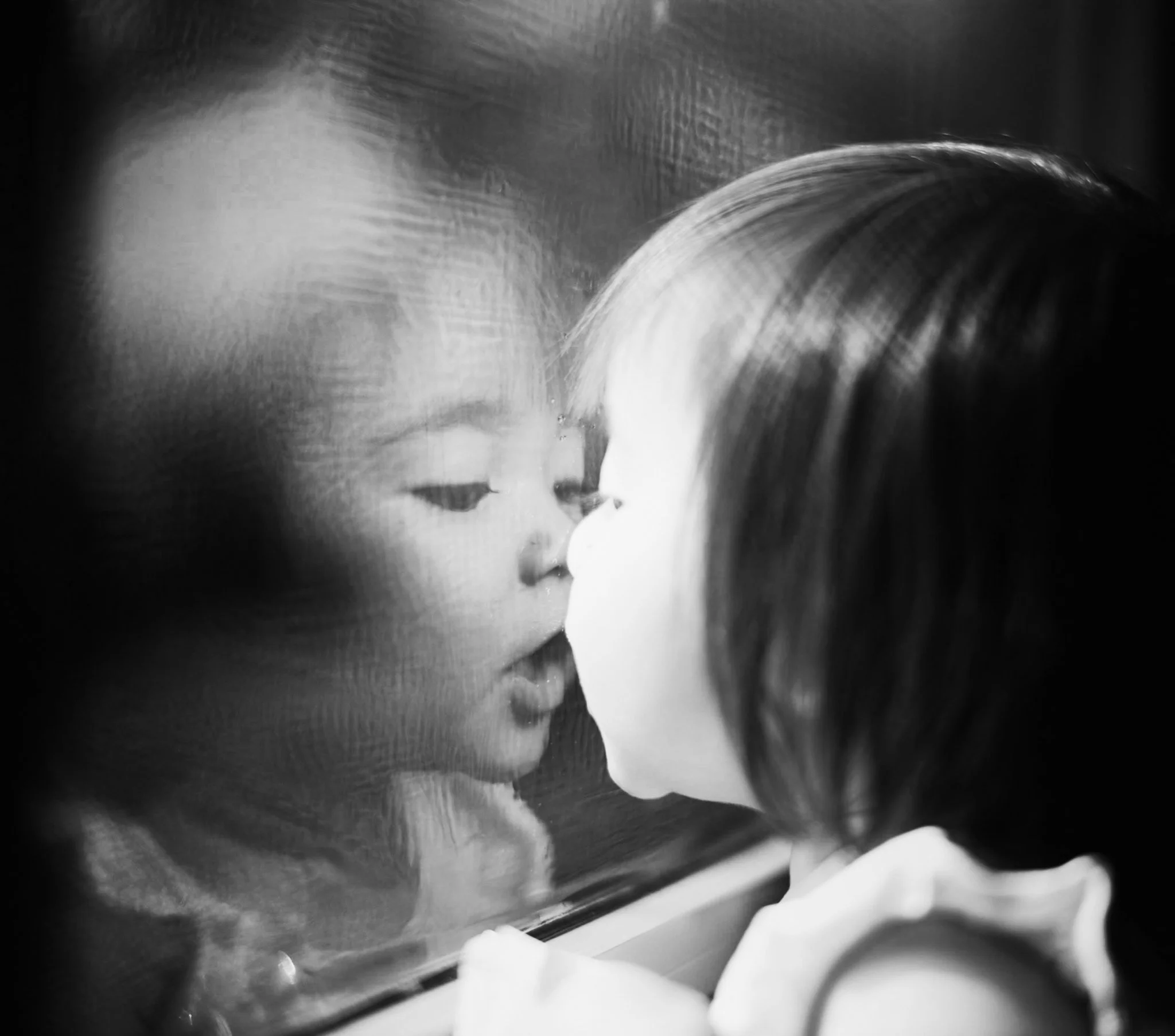
Davies. 2016. Sophie in reflection.
John Szarkowski, the influential American photography curator, critic and former Director of Photography at New York's Museum of Modern Art (MoMA), proposed that photographs could be understood as either mirrors or windows. Mirrors, he suggested, offer a "romantic expression of the photographer's sensibilities", while windows provide a view "through which the exterior world is explored in all its presence and reality" ⁽¹⁾.
This distinction captures one of photography's enduring tensions: the relationship between subjectivity and objectivity. Yet perhaps mirrors and windows are not opposing categories, but two ends of a continuum. Every photograph exists somewhere between them, its position shaped by the photographer's intentions. Is the image an attempt to document the world as it is, to record a moment of historical significance, or to express something of the photographer's own experience? And must these intentions be mutually exclusive?
A window, after all, can also be a mirror. Depending on the angle of view and the quality of light, it can simultaneously reveal the world beyond and reflect the person looking through it. Photography operates in much the same way. However objective our intentions, can we ever truly remove ourselves from the image? Or do we simply choose to overlook our presence within it?
Every photograph is the result of a series of decisions: where to stand, what to include, when to release the shutter, and how the final image is presented. Each choice reveals something of the photographer's perspective. Even the most straightforward documentary image carries the imprint of its maker. Our fingerprints, it seems, are always present.
I believe that our identities are inseparable from the photographs we take and make. While I recognise the value of both approaches, I have always been drawn to photography's origins as a medium associated with truth and the recording of reality. For me, however, its greatest potential lies in the space where observation and interpretation meet.
This intersection gives rise to intriguing possibilities: photography as self-reportage, where documenting the external world becomes a means of exploring the self, or as a form of artistic exposure, where personal expression emerges through the observation of reality.
There is a parallel in literature. Thomas Keneally's Schindler's Ark is associated with the idea of faction, a blending of historical fact and fictional narrative. Photography can occupy a similarly ambiguous territory. It may begin with the world as it exists, yet what emerges is inevitably shaped by the photographer's memories, emotions, intentions and experiences.
Canadian photographer Jeff Wall explores this territory in Mimic (1982), a photograph that appears to capture a spontaneous moment of street reportage. The image depicts three pedestrians passing one another on a Vancouver pavement, with one man making a racist gesture towards an Asian pedestrian. Yet the scene was not photographed as it happened. Instead, Wall carefully reconstructed an incident he had previously witnessed, using performers to recreate the encounter.
Jeff Wall, Mimic, 1982 — see the Art Institute of Chicago’s Jeff Wall archive.
Wall describes this approach as near-documentary, occupying an ambiguous space between observation and construction. The original event was real, but the resulting photograph is a personal interpretation rather than a direct record. Its apparent spontaneity conceals a deliberate process of staging and composition, challenging our assumptions about photographic truth.
In Szarkowski's terms, Mimic is both a window onto the world and a mirror of the photographer's experience. It documents a social reality while revealing how memory, intention and interpretation shape the images we make.
Perhaps, then, the most compelling photographs are neither purely mirrors nor purely windows. They allow us to look out at the world while simultaneously revealing something of the person behind the camera.
To photograph the world is, in some measure, always to reveal ourselves.
References
(1) SZARKOWSKI, John. 1978. Mirrors and Windows: American Photography since 1960. Press Release. Museum of Modern Art. Available online. Accessed 26 January 2022.
(2) WALL, Jeff. 1982. Mimic. Transparency in lightbox. See the Art Institute of Chicago’s Jeff Wall archive.